Eomuk어묵
Fish Cake Skewers in Broth
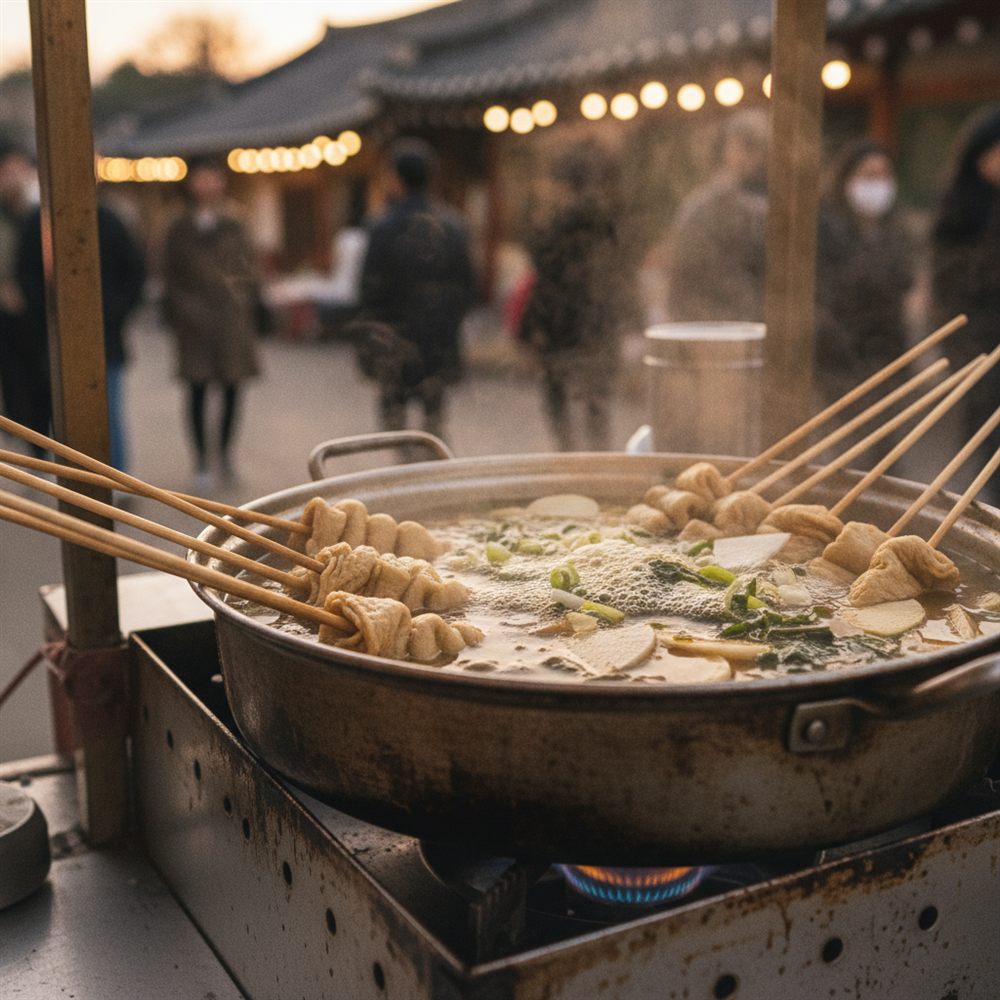
Flat sheets of savory fish cake folded onto skewers and simmered in a warm anchovy broth — the snack that keeps Korea warm in winter.
Similar to: The texture is much like Japanese kamaboko or a mild, springy seafood sausage, served skewered in a light, savory broth — think of it as a warming fish-based version of a hot-pot skewer.
KFG Score
How we rate →Eomuk appears in these rankings
The bottom line on Eomuk
If you are new to Korean food, Eomuk is one of the gentlest things you can order — not spicy at all, mild and savory rather than strongly fishy, with a soft bouncy texture. The part outsiders often miss is that the broth is really the whole point: on a cold day it warms you from the inside like a heated blanket. Just know it is genuinely made of fish and wheat, so it is one to skip if you avoid seafood or gluten.
Help yourself to a paper cup of the hot broth — at street carts it is free and refills are expected — and order it right alongside tteokbokki, where the mild broth is the perfect counter to the spicy rice cakes.
Want to try Eomuk?
Find Korean restaurants near you on Google Maps — see who serves it, with hours and reviews.
Affiliate link — we may earn a commission at no extra cost to you.
What is Eomuk?
Eomuk (also widely called odeng, from the Japanese-influenced name) is fish cake — ground white fish blended with starch and seasoning, formed into flat sheets, and cooked. On the street it is threaded in ribbons onto wooden skewers and kept simmering in a big pot of warm broth. This is one of the most comforting sights in Korea: a street cart on a cold day, steam rising off the pot, people standing shoulder to shoulder pulling skewers and sipping broth from paper cups. It pairs naturally with tteokbokki and is a fixture of pojangmacha (street tents) and bunsik shops. The broth is arguably the whole point — a clean, savory anchovy-and-kelp stock that warms you from the inside.
What does it taste like?
The fish cake itself is mild, savory, and pleasantly springy — a soft, bouncy texture rather than a strong fishy taste; it is more umami-savory than 'fishy.' It soaks up the broth it sits in, so each bite is warm and deeply savory. The star companion is the broth: light, clear, and comforting, seasoned with anchovy, kelp, radish, and green onion. Together it is soothing, warming food — the culinary equivalent of a heated blanket.
🌶️ Heat: Plain eomuk in broth is not spicy at all — it is one of the gentlest, most soothing street foods you can order. Some shops set out a soy-based dipping sauce with a little chili, and there are spicy stir-fried versions (eomuk bokkeum), but the classic skewer-in-broth is completely mild.
🧾 Key ingredients
- White fish paste (surimi)
- Wheat starch or flour
- Anchovy-and-kelp broth
- Korean radish (mu)
- Green onion
- Soy sauce (for the optional dip)
🥗 Dietary notes
This one is genuinely not vegetarian: the cakes are made of fish, and the broth is built on dried anchovies and often other seafood. It is also not gluten-free — fish cake almost always contains wheat starch or flour as a binder. Shellfish or fish allergy sufferers should avoid it entirely. It is a poor fit for most restricted diets, so it is one to skip if you are avoiding seafood or gluten.
To cook Eomuk at home you need
The rest is fresh produce you can buy anywhere. These are the Korean staples — buy once, and they keep.
The full Korean pantry, ranked by what each staple unlocks →
How to eat Eomuk
Grab a skewer from the pot yourself and eat the fish cake right off the stick. The unwritten rule of the street cart: you can ladle yourself a paper cup of the hot broth for free and sip it as you go — refills are fine, and it is the best part on a cold day. There is usually a small dish of soy dipping sauce to brush or dip the fish cake in. When you are done, you pay per skewer (the vendor counts your used sticks). It is the perfect companion to spicy tteokbokki — the mild broth cools the heat.
🍜 Common variations
- Eomuk-tang / odeng-guk (served as a broth-forward soup)
- Eomuk bokkeum (stir-fried, sometimes spicy — a common side dish)
- Busan eomuk (a famous regional style, prized for quality)
- Cheese- or vegetable-filled fish cake skewers
- Fried fish cake (deep-fried rather than simmered)
💡 Insider tips
- Help yourself to the free broth — ladle a paper cup and sip it; it is the whole cozy experience and refills are expected.
- Order it alongside tteokbokki; the mild, warm broth is the perfect counter to the spicy rice cakes.
- It is best in cold weather from a steaming street cart — that is when and where it shines.
- Brush the fish cake with the soy dipping sauce on the counter for an extra savory hit.
- Skip it if you avoid seafood or gluten — both fish and wheat are core to it, with no easy substitute.
Eomuk — FAQ
+ − Is eomuk the same as odeng?
In everyday Korean speech, yes — people use both names for the fish cake on skewers in broth. 'Eomuk' is the Korean word and 'odeng' comes from a Japanese-derived name; you will hear both at street carts.
+ − Does it taste very fishy?
Not really. The fish cake is mild and savory with a springy, bouncy texture. It tastes more of clean umami than of strong fish, which makes it very approachable.
+ − Is the broth free?
At street carts, yes — you are welcome to ladle yourself cups of the warm broth while you eat your skewers, and refills are normal. You pay for the number of skewers you eat.
+ − Can vegetarians eat eomuk?
No. Both the fish cake and the broth are seafood-based, so it is not suitable for vegetarians or anyone avoiding fish.
Sources & further reading
Written from first-hand experience. Recipes and spice levels vary by cook, region, and restaurant. If you have food allergies, always confirm the exact ingredients before you eat.