Jajangmyeon짜장면
Noodles in Black Bean Sauce
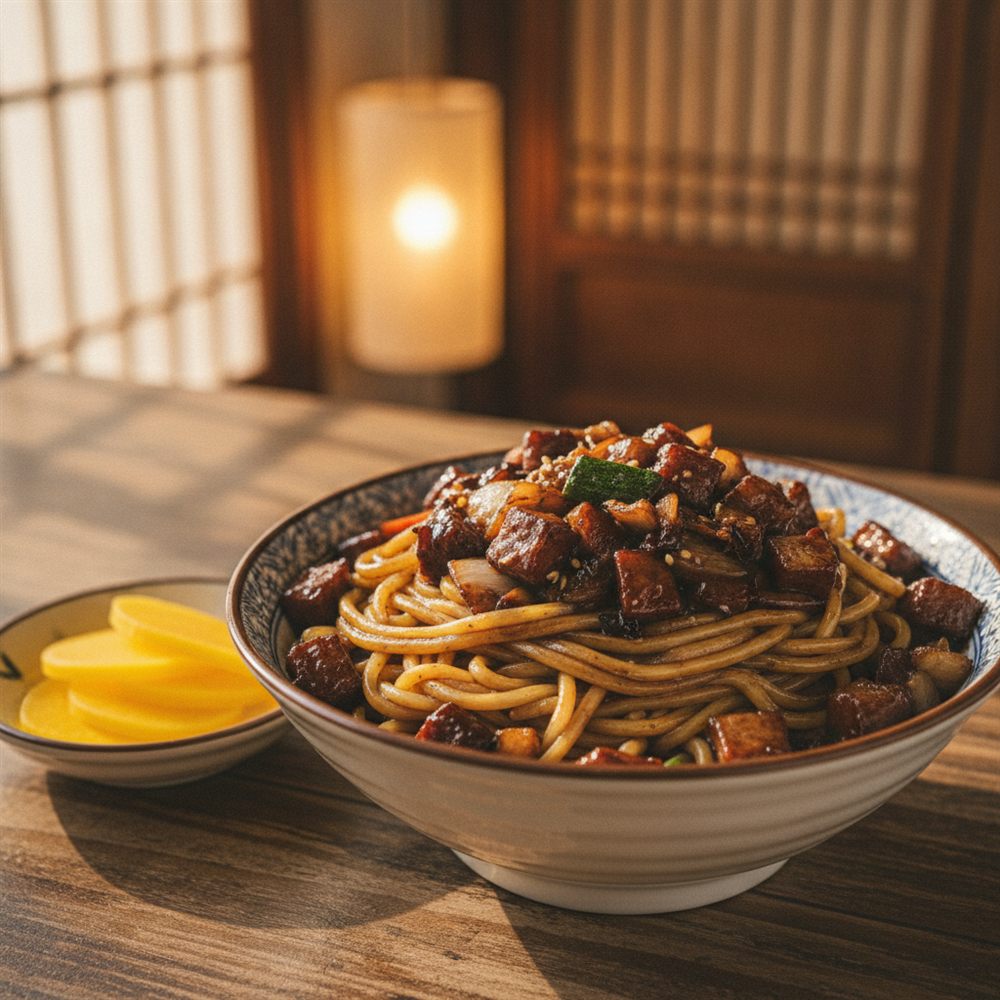
Chewy wheat noodles buried under a glossy, savory-sweet black bean sauce with pork and onions. Korea's number-one comfort delivery food.
Similar to: Imagine a heartier, Korean take on a savory pasta-with-thick-meat-sauce, but the sauce is a glossy dark fermented soybean gravy instead of tomato. The mix-it-yourself, sauce-on-top format is a bit like a deconstructed bowl of noodles you toss together at the table.
KFG Score
How we rate →Jajangmyeon appears in these rankings
The bottom line on Jajangmyeon
Do not let the jet-black color scare you — that is just fermented black bean paste, and it tastes rich and savory-sweet, never bitter. Jajangmyeon has no chili at all, so it suits anyone avoiding heat. For most of us it is the ultimate cheap, fast comfort meal, the classic thing to order for delivery on moving day.
The one rule is to mix it first — toss the sauce through until every noodle is coated black, then eat fast before they soften. Use the yellow pickled radish and raw onion to reset your palate between bites.
Want to try Jajangmyeon?
Find Korean restaurants near you on Google Maps — see who serves it, with hours and reviews.
Affiliate link — we may earn a commission at no extra cost to you.
What is Jajangmyeon?
Jajangmyeon is a bowl of thick wheat noodles topped with a thick, dark sauce made from chunjang, a fermented black soybean paste, stir-fried with diced pork, onions, and other vegetables. It is the flagship dish of Korean-Chinese cuisine, a style created by Chinese immigrants in Korea that has become its own thing, quite different from anything in China. For most Koreans this is the ultimate cheap, fast, satisfying meal. It is the classic thing to order for delivery on moving day, and college students basically live on it. Yes, the noodles look jet black under the sauce. That surprises a lot of first-timers, but that dark color is just the fermented black bean paste, and it tastes rich and savory, not bitter.
What does it taste like?
Deeply savory and umami-rich with a distinct gentle sweetness. The chunjang has a roasted, almost caramel-like depth, the onions cook down soft and sweet, and the pork adds richness. It is a bit oily in a comforting way. The noodles are thick and chewy, and you get a great contrast between the springy noodles and the thick, clingy sauce.
🌶️ Heat: Regular jajangmyeon is not spicy at all. If you want heat, order jjajang's fiery cousin instead: jjamppong is a spicy seafood noodle soup, and there is also a spicy version some places make. But standard jajangmyeon has zero chili.
🎬 Jajangmyeon in K-dramas & K-pop
Korea's famous 'black noodles' show up constantly on screen — including one Oscar-winning surprise.
- Parasite (2019) — The film's 'ram-don' is really jjapaguri — instant jjajangmyeon and spicy ramyeon boiled together and, in the movie, crowned with pricey steak. The eight-minute rush to cook it became one of the most talked-about food scenes in modern film.▶ Watch on YouTube
- Everyday drama life — Jjajangmyeon is the go-to moving-day and delivery meal on screen, and on April 14 'Black Day' singles are shown slurping it together in half-joking solidarity.▶ Watch on YouTube
Scenes are described for reference only; we do not host any clips or images.
🧾 Key ingredients
- Wheat noodles
- Chunjang (fermented black soybean paste)
- Pork (usually diced)
- Onion
- Zucchini or cabbage
- Potato
- A little sugar and oil
🥗 Dietary notes
Usually contains pork, so it is not vegetarian by default, but some places offer a vegetable-only version. It is not gluten-free (wheat noodles and wheat-based paste). Chunjang is soy-based. Because it is a restaurant and delivery staple, it is easy to find but hard to customize on the fly.
To cook Jajangmyeon at home you need
The rest is fresh produce you can buy anywhere. These are the Korean staples — buy once, and they keep.
The full Korean pantry, ranked by what each staple unlocks →
How to eat Jajangmyeon
First, mix it. The sauce arrives on top of the noodles, so grab your chopsticks and toss everything together until every noodle is coated black. Then dig in. It comes with danmuji (yellow pickled radish) and often raw onion with more chunjang for dipping, which cut the richness. Do not be shy about the mess; a little sauce on your face is practically a rite of passage.
🍜 Common variations
- Jajangmyeon (the classic)
- Gan-jajang (sauce served separately, drier, no starch thickener)
- Jaengban-jajang (made on a big pan, served on a platter to share)
- Samseon-jajang (with seafood like shrimp and squid)
- Jajang-bap (the same sauce served over rice instead of noodles)
💡 Insider tips
- Do not panic at the black color. It is fermented black soybean paste, and it tastes savory and slightly sweet, never bitter.
- Mix thoroughly before eating so the noodles get evenly coated. Un-mixed jajangmyeon is doing it wrong.
- Eat it fast. The noodles keep soaking up sauce and getting softer, so it is best in the first few minutes.
- Use the yellow pickled radish (danmuji) and raw onion to reset your palate between bites. The contrast is part of the experience.
- If you want spice, order a side of jjamppong or ask for a spicy version. The default is mild.
Jajangmyeon — FAQ
+ − Why are the noodles black?
The dark color comes from chunjang, a fermented black soybean paste that is the base of the sauce. It looks dramatic but tastes rich, savory, and a little sweet.
+ − Is jajangmyeon Chinese food?
It has Chinese roots but is really its own Korean-Chinese dish. It was created by Chinese immigrants in Korea and evolved into something you will not find the same way in China.
+ − Is it spicy?
No, the classic version has no chili. If you want heat, its spicy seafood counterpart, jjamppong, is what you are looking for.
+ − Why do Koreans eat it on moving day?
It is cheap, fast, filling, and delivers anywhere, so it became the go-to meal when your kitchen is packed in boxes. It is pure comfort food nostalgia for most of us.
Sources & further reading
Written from first-hand experience. Recipes and spice levels vary by cook, region, and restaurant. If you have food allergies, always confirm the exact ingredients before you eat.