Naengmyeon냉면
Cold Buckwheat Noodles
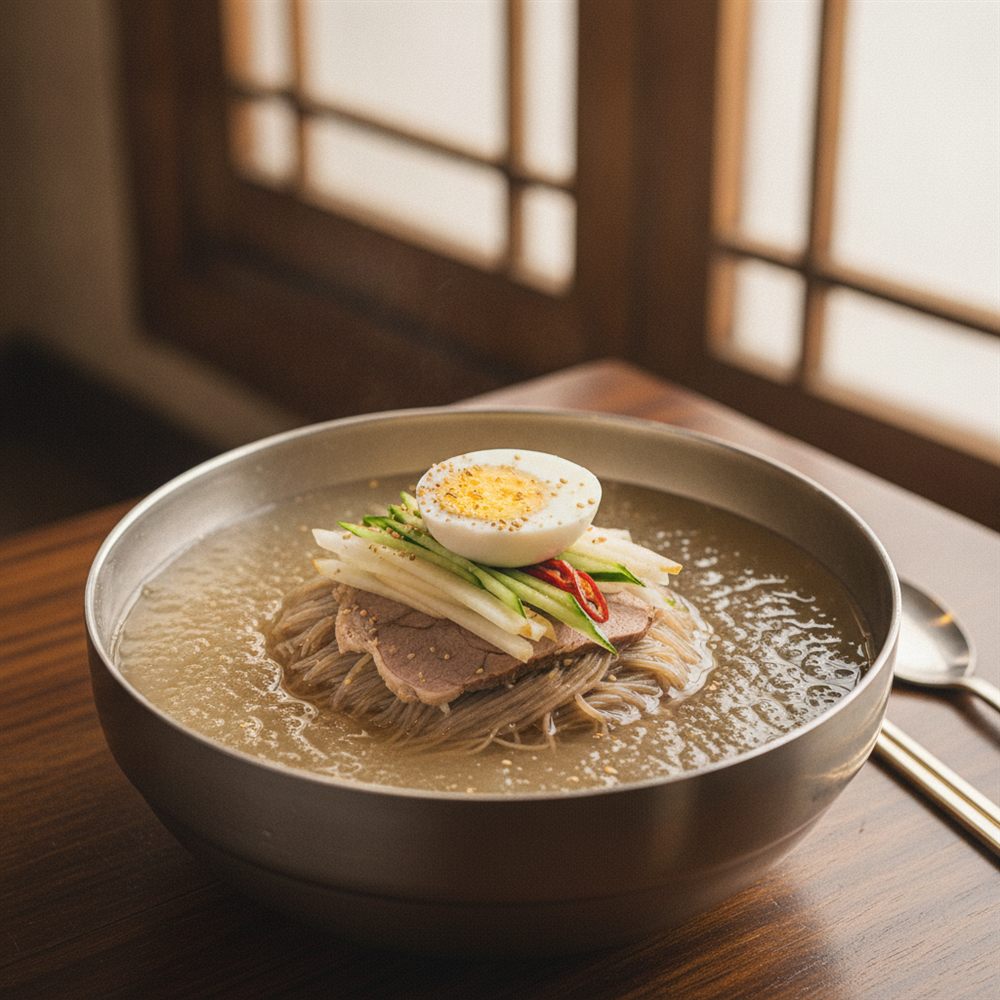
Chewy buckwheat noodles served ice-cold, either in a tangy chilled broth or tossed in a spicy sauce. Korea's answer to summer heat.
Similar to: There is not much in Western food quite like it, but the closest idea is a cold noodle salad or a chilled soba dish. Picture Japanese cold soba, then give it a chewier bite and either a tangy iced broth or a spicy Korean chili dressing.
KFG Score
How we rate →Naengmyeon appears in these rankings
The bottom line on Naengmyeon
If you are nervous about spice, naengmyeon lets you choose your own adventure — order mul-naengmyeon for a cool, tangy, completely mild broth, or bibim-naengmyeon if you want a bold sweet-spicy kick. For us in Korea it is the quintessential summer dish, the bowl we reach for to beat the brutal heat, though plenty of fans happily eat it year-round.
Do not skip the rituals: add the mustard oil and vinegar gradually until the balance is yours, and use the scissors to snip those famously chewy noodles — cutting them is completely normal, not rude.
Want to try Naengmyeon?
Find Korean restaurants near you on Google Maps — see who serves it, with hours and reviews.
Affiliate link — we may earn a commission at no extra cost to you.
What is Naengmyeon?
Naengmyeon means cold noodles, and yes, we really do eat them ice-cold, sometimes with actual slush floating in the bowl. The noodles are thin, springy, and chewy, usually made from buckwheat mixed with a bit of starch. There are two main types. Mul-naengmyeon is served in a clear, chilled, slightly tangy broth (mul means water). Bibim-naengmyeon has no broth; instead the noodles are tossed in a bright red, sweet-spicy chili sauce (bibim means mixed). Both are topped with things like sliced cucumber, Korean pear, a boiled egg, and slices of cold beef. It is the quintessential summer dish, though people who love it eat it year-round.
What does it taste like?
Mul-naengmyeon is refreshing, clean, and gently tangy, with a broth that is savory and a little sour and sweet, often made from beef and sometimes dongchimi (radish water kimchi). Bibim-naengmyeon is bold: sweet, spicy, tangy, and punchy. In both, the noodles are famously chewy, so chewy that scissors are provided to cut them. The cold temperature is the whole point; it wakes up your appetite on a hot day.
🌶️ Heat: It depends on the type. Mul-naengmyeon (the broth version) is not spicy at all, a 0. Bibim-naengmyeon (the sauce version) is moderately spicy, around a 3, from the gochujang-based sauce. So you can pick your heat level just by choosing the type.
🎬 Naengmyeon in K-dramas & K-pop
These cold noodles even made international headlines.
- 2018 Inter-Korean Summit — When the two Korean leaders shared Pyongyang-style naengmyeon at their summit, demand exploded and famous naengmyeon restaurants in Seoul saw hours-long lines the same week.▶ Watch on YouTube
- Summer drama scenes — A bowl of icy naengmyeon is on-screen shorthand for surviving the brutal Korean summer heat.▶ Watch on YouTube
Scenes are described for reference only; we do not host any clips or images.
🧾 Key ingredients
- Buckwheat noodles
- Chilled beef or dongchimi broth (for mul-naengmyeon)
- Gochujang-based sauce (for bibim-naengmyeon)
- Cucumber
- Korean pear
- Boiled egg
- Cold sliced beef
- Mustard oil and vinegar (added to taste)
🥗 Dietary notes
Traditionally the broth is beef-based and it is topped with beef and egg, so it is usually not vegetarian, though dongchimi-based broths exist. Noodles are buckwheat but almost always cut with wheat or other starch, so not reliably gluten-free. Bibim-naengmyeon sauce is soy- and chili-based.
To cook Naengmyeon at home you need
The rest is fresh produce you can buy anywhere. These are the Korean staples — buy once, and they keep.
The full Korean pantry, ranked by what each staple unlocks →
How to eat Naengmyeon
Here is the part that surprises visitors: at the table you will find a small pot of yellow mustard oil (gyeoja) and a bottle of vinegar. You add these yourself to the broth or sauce, to taste, before eating. Start with a little, mix, and taste. Use the provided scissors to snip the long noodles so they are easier to eat. For mul-naengmyeon, drink the cold broth directly from the bowl; it is meant to be sipped. For bibim-naengmyeon, mix everything thoroughly first.
🍜 Common variations
- Mul-naengmyeon (cold broth version, not spicy)
- Bibim-naengmyeon (spicy sauced version, no broth)
- Pyeongyang-naengmyeon (North Korean style, subtle buckwheat-forward broth)
- Hamhung-naengmyeon (chewier starch noodles, often the spicy hoe-naengmyeon with raw fish)
- Yeolmu-naengmyeon (with young summer radish kimchi and its brine)
💡 Insider tips
- If spice worries you, order mul-naengmyeon (the broth type). It is cool, tangy, and completely mild.
- Add the mustard and vinegar gradually. A little transforms the flavor; too much can overwhelm the delicate broth.
- Use the scissors. The noodles are intentionally long and very chewy, and cutting them is normal, not rude.
- Yes, it is supposed to be cold, sometimes with ice slush. That is the point on a hot day, not a mistake.
- Pyeongyang-style broth tastes subtle and almost plain at first. Give it a few bites; the clean buckwheat flavor grows on you.
Naengmyeon — FAQ
+ − Wait, the noodles are served cold on purpose?
Yes, completely on purpose. Naengmyeon literally means cold noodles, and it is a beloved way to beat the summer heat. Mul-naengmyeon often comes with icy slush in the broth.
+ − What is the difference between mul and bibim naengmyeon?
Mul-naengmyeon comes in a cold tangy broth and is not spicy. Bibim-naengmyeon has no broth and is tossed in a spicy-sweet red chili sauce.
+ − What is the mustard and vinegar for?
You add them yourself at the table to season the dish to your taste. The mustard adds a sharp kick and the vinegar adds tang. Start small and adjust.
+ − Why are the noodles so chewy and hard to bite?
That extreme chewiness is a prized feature, not a flaw. That is exactly why restaurants hand you scissors to cut the noodles into manageable pieces.
Sources & further reading
Written from first-hand experience. Recipes and spice levels vary by cook, region, and restaurant. If you have food allergies, always confirm the exact ingredients before you eat.